Monday, 9 November 2015

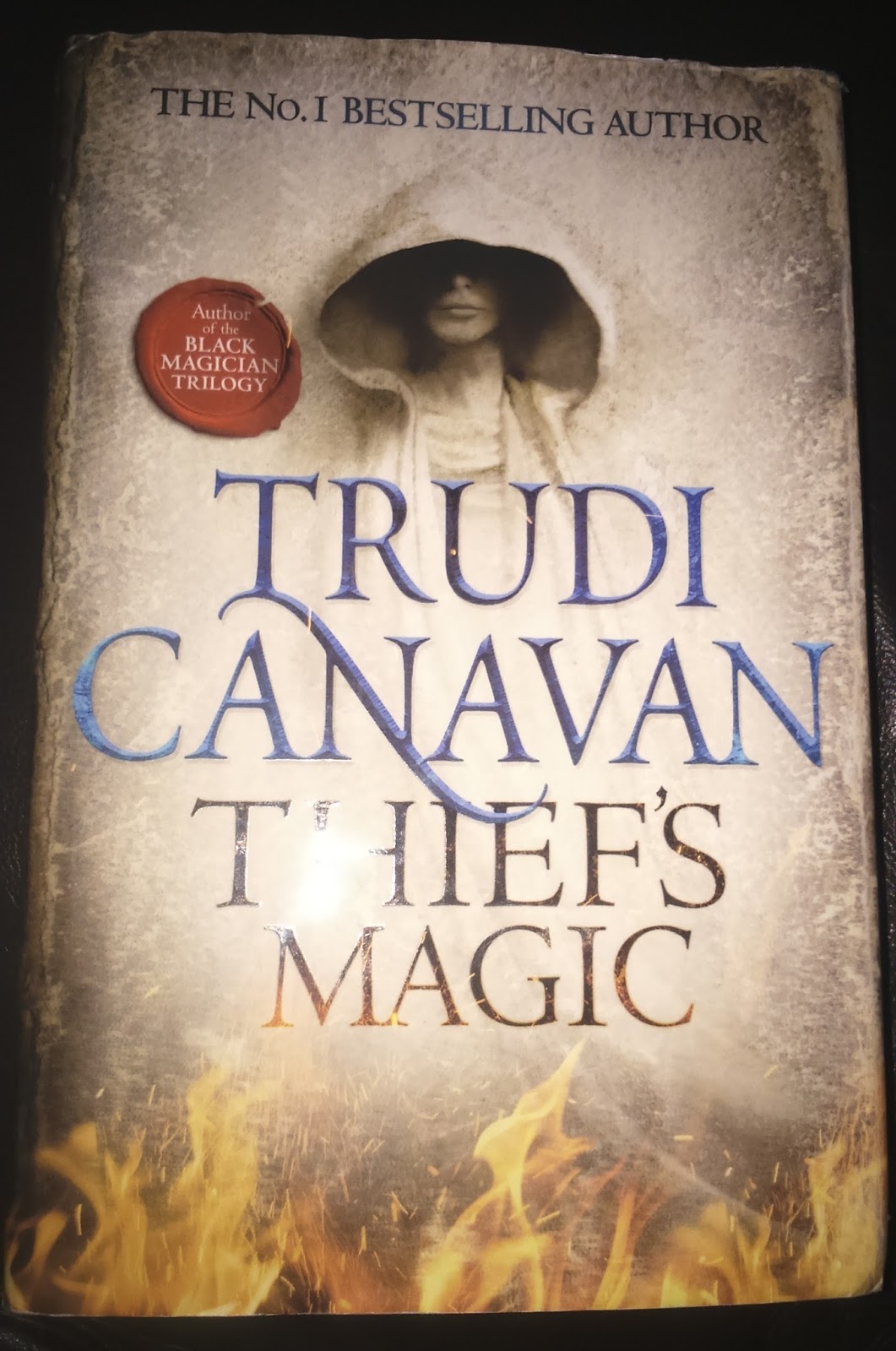
Thief's Magic

Thief's Magic
by Trudi Canavan

First published in Great Britain in 2014

Firstly, where is the year going??  I can't believe how quickly the months have flown by since I last posted and that I now have several books to blog about!

This book was on my 'to-read' list since I found out about it.  Having read several of Canavan's books now, I know I like her style and themes so I was fairly sure I'd like 'Thief's Magic'.  My plan was to wait until the paperback was released but then I was given the hardback by a friend so dived straight in.

It's the first in the new Millenium's Rule series and for me the first books are massively important in making me get into the story and thus the series. 'Thief's Magic' introduces us to two main characters who live totally different lives.  Tyen is a student at the Academy, which caters for people with magical talents.  Whilst on an archaeological study trip Tyen discovers a rare magical book.  The book is called Vella and 'speaks' to Tyen by making words appear on her pages.  Vella tells Tyen she used to be a human until an evil sorcerer turned her into a book.  He decides to secretly keep her, knowing that the Academy would lock her away in their storage centre if he showed her to them.  As Vella teaches Tyen more about her previous life and her life since becoming a book, he starts to believe in the ideas that people create magic and that there are lands that can be reached through magic - ideas that are hotly debated in the magic community.

Rielle is a young woman who lives in a land ruled by priests and faith.  She believes that to use magic is to steal is from the Angels, the highest power, but she knows she has a talent for it.  If a person chooses to learn how to use magic they are known as a 'tainted', and will have their soul ripped apart by the Angels when they die, so Rielle keeps her talent a secret.  After Izare, a painter, helps her after she is attacked by a 'tainted', she begins a relationship with him tears her apart from her family.  Rielle decides to seek magical help to prevent herself from becoming pregnant, but in doing so inadvertently makes herself infertile.  To reverse this she accidentally uses magic, and the fear of being discovered is suddenly very real.

Tyen's world is much more similar to the Sonea's in Canavan's 'The Black Magician' trilogy, in that the Academy is well-known and magic is accepted and it's study promoted.  Reading his story felt familiar to me which I liked, and I could easily picture his surroundings and fellow characters.  Tyen is a strong character who evolves quite a lot even just in this first book, and the way he interacts with other characters is relatable.  I particularly enjoyed reading the parts describing his adventures with Sezee and Veroo, two women he meets.

Rielle is in a very different land - hers is one ruled by religion and class.  Rielle's story is quite traditional, with the relationship between the upper and lower classes causing conflict, and her family life will feel familiar to most readers.  I found her a bit annoying at times because she has obviously been brought up well and expects her life to be a certain way, but this means she is very dependent on others and not very 'street smart'.  It is to Canavan's credit that just as I was starting to feel like all Rielle was doing was mooning around with Izare, the action suddenly kicked in.  Thinking back on it this is actually very clever of Canavan, as I was feeling safe in Rielle's story, as she was in her life, until it was turned upside down.

The story alternates between Rielle and Tyen, which some readers may like more than others.  Personally I liked this technique, as it meant I was constantly going along with both of them, however it did feel at times that I was reading two separate books.

Whilst reading I was waiting for Tyen and Rielle to meet, as I had decided that was the way the story was heading, and I had to keep reminding myself that this is only the first book in the series.  It'll definitely be one that I continue to read when the next books are released.

The book as a whole is really easy to get stuck into and I read it in a couple of sittings (sleep and work were the only things getting in the way).  The characters are well-rounded and easy to relate to, just as I have found with the other books by Canavan that I have read so far.  I would have liked a map included (I do love a good map) so I could follow where the characters were a bit easier, but I appreciate that the different lands might have made this difficult.  The descriptions are vivid and it is easy to get lost in one land and then another.

I'm excited for book two ('Angel of Storms', eeep) to see how and where we meet up with Tyen and Rielle - it's released on the 12th so not long to wait now!

Wednesday, 12 August 2015

To Kill A Mockingbird

To Kill A Mockingbird
by Harper Lee

First published in Great Britain in 1960

To Kill A Mockingbird has been on my ‘to-read’ list for a very long time, but just never quite made it to the forefront of my mind when I’m stood in a bookshop.  I finally remembered to buy it and read it pretty quickly.  It’s not a long book anyway but it’s also pretty easy to read.  On the back cover of my copy is a quote from The Independent: ‘No one ever forgets this book’.  With this in mind I feel like I put quite a lot of pressure on it.  It’s definitely one of those classics that everyone is supposed to not only have read but also felt a deep connection to.

In the Deep South in the 1930s a black man is accused of attacking a white girl.  Atticus Finch is the lawyer defending Tom Robinson and Jem and Scout are his children.  Written from Scout’s point of view, To Kill A Mockingbird confronts the issues of race and injustice with smatterings of childhood innocence.

Scout is a young girl with a keen interest in the goings on of her town.  She is inquisitive and has an innocence that cuts through the harsh realities of the trial.  Jem is her older brother and I really liked him.  He and Scout are close friends who are inseparable as they have brilliant summers together with their friend Dill.  As they grow up he tries to explain things to Scout and always looks out for her.  I think a lot of present-day teenage boys could relate to Jem, which shows me how good a writer Lee is.


Atticus Finch is the hero of the story.  He tries to bring up his children with strong morals and I loved how he talked to them and took their worries seriously.  Atticus is well respected in his town, and the fact that he goes against the majority of people’s opinions about Tom Robinson brings him a lot of trouble.  To me, the way he continues to be a friendly person, even to people who are openly against him, says a lot about his character.  I haven’t yet read Go Set A Watchman and I have heard various things about Atticus’ character in in, but just from To Kill A Mockingbird I really liked him.

The townspeople are a strong mix of 1930s attitudes.  From the Finch’s closest neighbours to the black community everyone has an opinion on what is happening and each person is portrayed well enough that I could remember who was who (always important to me!)

The book starts when Scout is almost six and finishes when she is nine.  Jem is four years older, which allows him to sound believable when he advises his younger sister whilst still playing games with her.  Lee wrote the book from Scout’s adult perspective of her childhood experience, which makes her thoughts more organised than if her six year old self had ‘written’ it.  That being said, Scout was clearly a very observant child.  I liked the writing style as it was childlike in it’s innocence but not overly simplified.  It made a rather heavy subject readable, and the characters more relatable

The conversations are written as they were spoken, with slang and colloquialisms.  This takes a bit of getting used to but the voices were soon set in my mind and it helped to bring the characters’ strong personalities to life.

I enjoyed this book.  I always think it’s difficult to read or watch something which has a lot of hype about it, and for this reason I usually wait until it has died down a bit.  The hype was up again around To Kill A Mockingbird, probably because of the sequel being released, and so I was asked what I thought a lot as I read it.

The characters were very relatable and the story was really interesting.  As I’ve said, I read the book quickly and this is down to the writing grabbing, and holding, my attention.  I think Go Set A Watchman will definitely be on next year’s reading list (or maybe I’ll sneak it into this years) and I look forward to seeing if it changes my opinion.  I’m not sure if I’d say I’ll never forget this book, but it was definitely one I’ve talked about with people a lot.

Tuesday, 30 June 2015

A Lovely Way To Burn

A Lovely Way To Burn
by Louise Welsh

First published in Great Britain in 2014.

This book has been on my 'to read' list since it was in the Metro article I've now mentioned a few times in this blog.   It interested me because it seemed to be about a plague in modern times, in a similar vein to post-apocalyptic fiction.  I like reading post-apocalyptic fiction because I like wondering how society would function and how I would react to the situation (I'm aware I'd probably not do well!).
A Lovely Way To Burn is the first in a trilogy called 'Plague Times' and it does end with a fairly open way into the next book, I think.

Set in present ish day (described as 'a time that could be tomorrow) London, Stevie is the main character when a virus suddenly takes hold.  Soon there are more people dying than doctors can cope with and there doesn't seem to be a cure.  However, Stevie has had 'the sweats' and survived.  When her boyfriend dies and it looks more like murder than the virus she has to try to find out who killed him, whilst also fighting for her own life.

Stevie is a character that I kept changing my mind about; even as I write this I'm not sure if I like her.  Initially I found her annoying.  She was self-centred and in her own little London bubble.  As the story progressed she acted in ways I could understand.  As the story was set in the present day I found parts of it worryingly real, for example when Stevie sees a man die in the London Underground and the panic that ensues.

I think one reason for my going back and forth on Stevie's character was the fact that she was soon the only female surrounded by a lot of male characters, and as a female I wanted her to keep going and 'win'.  On the other hand I didn't relate to her personally very much, and so I wasn't really rooting for her at all.

The writing is very straightforward.  I thought Stevie was a bit over-dramatic at times but I was able to see this as a realistic reaction for her.  The story is written in the third person narrative, which I think was a big factor in my not fully connecting with the characters.  The narrator is limited to Stevie's feelings and emotions so she is the main character, however she wasn't one that I related to as much as characters in other books.
The medical lingo is used enough to illustrate how dangerous the virus is, without being too hard to understand, and as Stevie isn't a medical professional she asks for explanations when I needed them.

Overall, it was a decent read but I did get frustrated with Stevie and this had a big impact on my enjoyment of the book.  I know I'll read the next two in the trilogy just because I can't not know what happens when I start something.  I was considering not writing this review because it wasn't a brilliant read for me, but I didn't want this blog to sound enthused about everything all the time (unrealistic much?).  Ofcourse I may not like everything I read in the same way, but every book has something to give.  This one made me realise that I much prefer reading about the initial impact of post-apocalyptic events, for example how the virus affects people day to day, rather than the thriller aspect of Stevie trying the find her boyfriend's killer.  Maybe I'm just rather morbid!

Wednesday, 29 April 2015

The Wonderful Wizard Of Oz

The Wonderful Wizard Of Oz
by L.Frank Baum

First published in 1900.

I love the Wizard Of Oz film.  I watch it again and again and have long discussions about the evil Tin Man - watch the hot air balloon scene again - with my friend Jemma (of her cup of tea).  I sing along, I've attempted the yellow brick road dance and have even dressed up as Dorothy for a university night out.

This is starting to sound like an obsession, I promise it's not.

All of this being true, I have somehow never read the series.  A friend got me this lovely copy for Christmas and I really enjoyed it.  Story aside, the book itself is wonderful.  It is a copy of the first edition, complete with twenty-four colour plates and 130 two colour illustrations, which are interspersed with the text like this...


How beautiful is that?!

If you've seen the film you'll know the basic story.  I was expecting to read the film plot chapter by chapter but there are characters and whole sections in the book which didn't make it to the film.  It's a bit more like a collection of short stories within the over-arcing plot of Dorothy trying to get back to Kansas.

Dorothy is a young girl who ends up in Oz after a cyclone lifts her and her house from Kansas.  She meets the Munchkins and the Good Witch who tell her to go to the Wizard of Oz who will help her get home.  Along the way she meets the Scarecrow, Tin Man and Cowardly Lion who decide to go with her to ask the wizard to help them too.  On their journey they come across Kalidahs, who have bodies of bears and heads of tigers, Quadlings who have no arms but necks that extend, and tiny people made of china who break if they fall over.  All in all it's a bit strange but it definitely paints a vivid picture as you read.


One thing that did make me laugh was the amount of washing Dorothy did.  Every time they stopped somewhere she washed herself in a stream or someone's house.  Clearly the author felt a responsibilty to gently tell the readers to look after themselves, and it's not in a lectury way, I just felt that in all the adventure that was going on, it was such a grounded thing to be doing.

The writing is straightforward enough for children but as a (slightly) older reader it didn't feel too simple or patronising.  This is possibly because I saw the film when I was younger so I felt quite nostalgic reading it, but I fully believe in the ability of a book to take you to another world and this one definitely does.

I appreciate this might not be one you'll rush out and buy because you think it's a kids book, but it will remind you of being young and carefree.  If everyone re-read their favourite book from when they were younger once a year I think we'd all be a lot happier.

What's your favourite book to re-read?

Monday, 16 March 2015

The Fault In Our Stars

The Fault In Our Stars
by John Green

First published in Great Britain in 2012.

The Fault In Our Stars is a book off my 'To Read' list for this year.  For a while after the film came out there was talk everywhere of 'Okay? Okay' - I even saw it on a tshirt in Primark.  I never got around to seeing the film but wanted to read the book once the hype died down (less chance of someone asking if I was up to 'the bit where......happens'?).  I did end up knowing certain plot points by the time I read it but not enough detail to have it ruined.

Hazel is a sixteen year old with terminal cancer.  Augustus Waters is a seventeen year old who has had osteosarcoma and is an amputee as a result.  The two meet at a Cancer Kid Support Group and are soon inseparable; Augustus even manages to organise a trip to Amsterdam for Hazel, her mum and himself to meet Hazel's favourite author.  As their relationship deepens and they help each other through hospital visits and a friend's issues, the backdrop of cancer is always there.  A plot twist eventually brings sadness to their love story.

Even though The Fault In Our Stars is a book mainly about teenagers it is one I believe a lot of adults would enjoy too.  The characters are maturely written, not made out to be your stereotypical high school kids.  The book is fairly concise; at only 313 pages it's short enough to read in a week or less (which I did) and then re-read before you have to give it back to the library.  


Although it is written from Hazel's point of view it is not childish and is at times emotionally quite hard.  Obviously cancer is horrendous, yet it is something which most of us will have some dealing with in our lives.  I have often heard that people who have cancer sometimes find a sort of humour in their situation, and this is definitely true for the characters in this book.  Cancer is the first link between Hazel and Augustus and continues to feature heavily in their story, from their friend dealing with losing his sight to Hazel's ever-present oxygen tank.  

The characters do not let it define themselves but they are also not cheesily optimistic all the time.  I think this is a much more realistic view; allowing the characters to scream and cry and shout that it isn't fair is a lot better (although emotional) to read than if they were these 'this won't affect me at all', unrelatable people.

I thought that Hazel was a well thought through character.  She wasn't just an angry teenager who has cancer.  I may be a bit biased because she loves reading and I know what it's like to feel obsessed with a book,  but I felt I could relate to her - I felt like we would have been friends in school if she were real.  She cares so much about the people in her life and says that she knows she is a grenade who will explode one day so wants to minimise the casualties.  I thought this was a very mature way of looking at her situation (plus it gave Augustus the chance to be all cheesy and sweet).  Hazel's matter of fact way of looking at her life is refreshing and makes it even more emotional when she is upset.

Augustus comes across as a bit of a cocky lad at first.  When he tells Hazel he is looking at her because she is beautiful at their first meeting I thought 'oh heck here we go with the over the top teen romance'.  I think because Hazel reacted the same way I did as I was reading, he grew on me the same as he grew on her.  He is similar to Hazel in that he understands the pain people can cause.  One of my favourite lines from the book is one of his: 'You don't get to choose if you get hurt in this world, old man, but you do have some say in who hurts you'.  As sad as this sounds, that pain is inevitable, I like the idea that you can decide to let it get to you or not.

I won't spoil anything if you haven't read this great little book, but I will say that I cried.  A lot (at one point I had to stop reading it on a bus because tears were threatening to fall and it was first thing in the morning).  I found that I cried at random parts that you wouldn't even think to be sad at.  To me, that was the best bit about The Fault In Our Stars.  Even though I sortof knew what was coming, the story still hit me harder than I thought it would and I felt sadness in moments that you wouldn't immediately expect, particularly between Hazel and her parents.

Don't let the 'young adult' label put you off this one, let it teach you a better way to look at life.  And maybe don't read it on public transport unless you have a heart of stone.

Friday, 6 March 2015

Wild

Wild
by Cheryl Strayed

First published in Great Britain in 2012.

Wild is wonderful.  I saw the film trailer and knew it was one I wanted to see.  When I learnt it was based on a book I went straight out and bought it.  Then I had that annoying time when you're still reading another book and so can't start the new one yet (thankfully the other book was Life After Life - see previous blog post - and I couldn't put it down so was finished pretty quickly).

I think I read Wild in about two weeks, it was another one that I really struggled to put down and go to work.  At the same time, because I was enjoying it so much, I didn't want it to end, so I sortof read it slower than I would otherwise have done.  That probably makes very little sense but I do it a lot with books, re-reading bits and so on to extend the reading time.

The story is of Cheryl Strayed, who at 26 decided to hike 1,100 miles of the Pacific Crest Trail alone after her mother died suddenly.  Cheryl hikes through deserts, snow and forests meeting other hikers along the way but staying alone for the most part.  The story of the hike is interspersed with stories from Cheryl's childhood living with her mother and siblings, and her struggles after her mother's death when Cheryl was 23.


Cheryl is a strong, resiliant person but she doesn't realise it at first.  Her mother's death tears her apart and she turns to one night stands and drugs to try to cope.  She realises that she is damaging herself and those around her and makes the rather spontaneous decision to hike the trail.  Throughout the book she gains strength from seeing how far she has come and allowing herself to grieve for her mother properly.  A lot of people would say she is brave, and I agree but not in the sense that she is hiking this potentially dangerous trail alone.  To me, Cheryl doesn't realise the scale of potential danger and so is not afraid of this.  Her bravery comes from choosing to change her life from the depths it was sinking into.

The writing is straightforward and unapologetic, rather like Cheryl herself.  I found it very relatable as a 26 year old, even though I have definitely not hiked on my own (or much at all for that matter!).  It is so detailed in the descriptions of the trail that it is easy to imagine yourself there with Cheryl.  I laughed and cried with Cheryl.  She doesn't shy away from her emotions, especially when she is on the trail and feels safe in her grief.

There are parts which are very much about the technical side of hiking, for example when Cheryl is packing her rucksack, and when she faces snow for the first time.  These parts are detailed but because Cheryl hadn't researched or trained before the hike, the writing is understandable even if you have never worn a rucksack.  I felt as if I were learning along with Cheryl, and shared in her victories.  I so badly wanted her to reach the end of the hike that I was fully cheering her on at times.

When I first started reading it I loved that Cheryl's last name was Strayed, what with her 'straying' from her day to day life to hike and all that.  As it turned out she chose this last name herself.  At first I was disappointed to read this as I liked the idea that her name was more than just a name, that it was part of her personality that she would find as she grew up.  Looking back on it now, I admire Cheryl for carving her own identity by choosing a new name, particularly as the close bond with her mother is not one she discards with the old name.

I kept picturing Reese Witherspoon as Cheryl as I read the book, because of her looking at me from the cover every time I picked it up.  This wasn't necessarily a bad thing, but I do think it stops you from imagining a character if a casting director has decided what you should be picturing.  I was glad to see that the book's descriptions of Cheryl and photos of actual Cheryl from when she did the trail are pretty similar to Reese.  I find it so unnecessarily annoying when a characters hair colour or something equally small is changed.

This book is obviously a great one for holidays, gap years and walking weekends (if you have time to read in your tent at night).  For me, it was an escape from the daily commute to the trail in North America.  The book made me want to up and travel somewhere far away with a massive rucksack (although this feeling soon stopped once I finished reading!).  It was made even better by the fact that it was real; Cheryl exists and really did hike the trail.

If you get itchy feet easily, get this book on your bookshelf.  I take no responsibility for it making you want to leave your day job and go travelling.

Thursday, 19 February 2015

Life After Life

Life After Life
by Kate Atkinson

First published in Great Britain in 2013.

Ursula is born but dies minutes later.  Ursula is born and lives.  Second chances, the ability to change the future and deja vu are all themes of this story, set between 1910 and 1967.  It concentrates mainly on the 20s and 30s and has great detailed accounts of the second World War in both London and Germany.

I was given this book as a Christmas present by a friend and it is brilliant.  If you've ever wished you could change something in your past, or wondered how your life might be different had something been changed, then give this a read.  I could write a pages long essay on this book; it is full of events, characters and places so detailed I really felt like I was there in the story.  I know that sounds incredibly cheesy but I just got lost in this book. The ideas of dreams, deja vu and second chances are explored in a way that makes you think about your actions and their consequences, without being too heavy handed.  It made me think about my place in the world (cheese again!).


The story follows Ursula from her birth to her death.  She grows up in the English countryside with her mother, Sylvie, and siblings.  When she is young, Ursula tries to stop bad things happening in rather childish ways, for example pushing the maid down the stairs in an attempt to stop her going to London where she contracts Spanish flu.  As she gets older Ursula understands more the consequences of her actions but continues to try to protect the people she loves.  We see her go though several relationships and I was hoping that one in particular wouldn't be the lasting one (no spoilers!)  The relationships were very well written, with the different men bringing out different sides to Ursula's personality.

The only characters I didn't like were Derek (no spoilers so I won't go into it) and Sylvie.  She seemed cold and distant, even towards her children.  When I finished reading I did think that perhaps she also had the ability to go back in her life and change things like Ursula.  I thought it was hinted at that she had once had a fancier life with a gentleman in a hotel, but for some reason this didn't stay as her real life, so perhaps she was bitter about this.

There were several parts of the book which hinted at pretty dark, grim things happening.  Not enough to be graphically obvious straight away but disturbing when thought about.  I felt this gave the timelines a lot more depth, especially the smaller storylines.  I think that the fact that not everyone gets their 'happy ending' shows that whatever you do to help one person may end up backfiring, even if it is not immediate.

The account of the London Blitz is one of the best I have read; it is so detailed and realistic and certainly doesn't hide from the grimness of the time.  I found it really interesting to read and compare Ursula's experiences in London and Germany during the war and the fact that her different experiences were caused by the simple act of her returning to England or not was striking.

The ending is rather vague and at first I was unsatisfied because it didn't give a roundup of each character.  Looking back on it I think that, although I'll always find it frustrating because that's just who I am as a reader, everytime I read it I'll probably interpret it differently.

I know I'll be reading this book again and again, and I definitely want to do so with a notebook so I can try to keep track of the back and forth a bit more!

Monday, 26 January 2015

Station Eleven

Station Eleven
by Emily St. John Mandel

First published in Great Britain in 2014.

A newspaper introduced me to this book.  Last year the Metro had a full page article about apocalyptic novels and how they were on the up, so I went through the article and highlighted the books it mentioned to add to my 'To Read List'.  For my birthday a friend got me one of these books - Station Eleven.  It was only out in hardback at the time but it's out in paperback now, incase you have a preference.

It's a story that goes back and forth in time, from a world readers would recognise as similar to ours to one set after a massive flu pandemic has caused the collapse of society.  There are several major characters in both the world before and the world after the collapse.  I particularly liked Jeevan, a man who's doctor friend warns him about the flu just in time.  He was the character I related to the most, as I often wonder what would happen if things like pandemics happened out of nowhere.  As I was reading this book the Ebola crisis was in the headlines every day, and was suddenly becoming a real fear that the world was having to deal with.  The book did make me think what I would do in the situation Jeevan faced.  I thought things like the news being read by cameramen because the newsreaders had died was very realistic and well written, and something I hadn't thought of.  Jeevan's story made me realise how much we take for granted in the way society is run, by so many people all playing their parts.   


Post-collapse, I found myself relating to Clark's character.  He is an older man who is stranded in Severn City airport when his flight is diverted due to the outbreak. He takes it upon himself to make a museum of sorts in the first class lounge, for items that are no longer needed but that people don't want to simply throw away.  It becomes full of everyday items, from high heels to mobile phones, and I felt I too would want to save some part of the world I had grown up in if it were me.  After sixteen years in the airport 'settlement', Clark is explaining to a sixteen year old what planes were and why airports existed.  She was born in the airport and has no knowledge of the world before the flu outbreak.  This was interesting and a bit strange to imagine, and I found myself wondering what people would think of our world if I had to try to explain everyday objects to them.

The Travelling Symphony was a brilliant little group that I felt I was travelling along with.  They are a group of survivors who have found each other wandering the country and go around performing Shakespeare to other survivors in towns as they pass through.  They do this simply to keep their love for acting and music alive, which I could very much appreciate.

This book stayed with me a long time after reading it (such a cliché I know) and I would definitely recommend it, whether or not you like post-apocalyptic fiction.  It has a good amount of time before and after the collapse, and the flu outbreak is detailed enough to make it seem worryingly realistic.  I felt the characters were well-rounded, even those who only said one line.  An example of this is a lone man who appears at the airport a hundred days after the outbreak.  He is crying.  When the other survivors ask him why, he says he thought he was the only one.  I felt his absolute relief at finding other survivors, and his few short lines made me imagine his struggle, believing that he was the last survivor on earth.

So to sum up, get Station Eleven added to your 'To Read' list right now!

Wednesday, 7 January 2015

New Year, New Reading List

After a bit of a longer gap in posts than I meant (the festive season kinda took over life), the arrival of 2015 has made me think about the books I want to read this year.

I decided to put together a list of  twelve books, so that I can buy one each pay day and have plenty of time to read them even when times get hectic.  I've actually ended up with eleven, as I couldn't decide between about seven others to make twelve, so I'll add to this if/when I do choose.

In no particular order, here goes...

1. Wild by Cheryl Strayed.
This memoir of a young woman's solo trek along the Pacific Crest Trail is about to be released as a film, and although I want to see it, I reckon I'll get more from the book.

2. The Perks of Being a Wallflower by Stephen Chbosky.
This and the next on the list are simply books that I never got around to when they first came out.  They everybody was raving about them and I knew that would affect my reading, so I've waited a while to enjoy them more.

3. The Fault in Our Stars by John Green.

4. Thief's Magic by Trudi Canavan.
This was out last year and I was debating whether to wait until the whole trilogy was released so I could read them all in one.  I've now decided I can't wait and so will be buying this soon.

5. To Kill A Mockingbird by Harper Lee.
This book has been on my 'To Read' list for a long time but has somehow never come to the forefront of my mind.  This is the year.

6. Mobile Library by David Whitehouse.
This one was in a magazine in their 'new books section and the very short blurb caught my eye.  It's apparently about the way that the books we read as children inspire us, so I'm looking forward to this one a lot.

7. A Fraction of the Whole by Steve Tolz.
A friend recommended this to me after I posted for ideas on Facebook.  Let's see how it goes.  I'm always a bit afraid of reading peoples' favourite books incase I don't like them (I feel very protective over my book choices) but then that's what makes the world interesting.

8. Fight Club by Chuck Palahniuk.
Another recommendation.  I liked the film and I'm interested to see how it works in a book.

9. The Library of Shadows by Mikkel Birkegaard.
This and the next book were recommended to me by www.openingthebook.com/whichbook and both sounded beautiful and magical.  I'm expecting similar to The Shadow Of The Wind and The Night Circus.

10. The Girl With Glass Feet by Ali Shaw.

11. A Lovely Way To Burn - Louise Welsh.
One from last birthday's wish list that I didn't end up receiving.  It sounds like a good bleak story of a modern plague in London with a murder mystery thread.  It's also the first in a trilogy, so I hope it'll be a good introduction.


What's on your 'To Read in 2015' list?

Saturday, 18 October 2014

The Magician's Apprentice

The Magician's Apprentice
by Trudi Canavan

First published in Great Britain in 2009.

I was introduced to Trudi Canavan by my boyfriend.  He reads a lot of high fantasy and suggested Trudi Canavan to me because her main characters tend to be strong females and the stories are more to do with daily life than violent wars, for the most part.  When I got the book and saw it had a glossary at the back and maps at the front, I was pretty much sold.

The Magician's Apprentice is set one hundred years before The Black Magician Trilogy, and is a great introduction to her writing.  The main character is Tessia, a healer's daughter from peaceful Kyralia who helps her father with his work.  One day they are at the local magician's house, attending to a sick slave who belongs to a visiting Sachakan magician from the neighbouring country of Sachaka.  Whilst there, the Sachakan master attacks Tessia and she responds with magic she didn't know she possessed.  As she is a natural, the Lord (who is also a magician) takes it upon himself to train her to be a full magician.  As her training progresses tensions are rising with Sachaka, with rumours that Sachakan magicians are going to invade Kyralia.

The story is interspersed with that of Stara, a young woman who is moving to Sachaka to live with her father.  Although not a magician, Stara has learnt some magic from a friend and hopes to use this to help her father with his trade.  However when she arrives, she learns that he intends to marry her off so she will provide him with an heir.  As she struggles to adapt to Sachakan life she is taught higher magic in secret and becomes an integral part of the close circle of local women who plan to leave Sachaka.

There are also parts focusing on the Sachakan magicians as they attempt to invade Kyralia.  Their intense malice is a strong contrast to the morals of the Kyralians and gives a feeling of unease as you read.

I really like both Tessia and Stara.  They are both strong women who have to deal with difficult situations.  I find Tessia's story more interesting as she travels with the magicians and grows from a confused girl to a confident woman.  She is the only female apprentice and she copes with this with strength and humour.
Stara's story mainly focuses on her relationships - with her slave, her father, and the other women she meets in Sachaka.  Her struggle is with her family's expectations of her.  However with the invasions comes a different responsibility for her and Stara really comes into her own and seems the most sensible of the women at times.

The war is believable in that it builds slowly, with small events that have knock on effects, just like in reality.  I really cared about the characters, and felt the sadness that they felt when their villages were attacked.  The writing hints at the evilness of the Sachakans without being overly emotional.

The whole world is really well created, down to the smallest details.  There are a fair few different words for things but most are understandable just from the context (there is a short glossary at the back of the book as well).  The maps at the front of the book are a great help to see where each character is at each part of the story.  I get totally lost in the story, thanks to the detailed descriptions.  It is easy to put yourself in the rooms with the characters, which is always important to me.

The book is an excellent prequel to The Black Magician trilogy - it tells the reader how things like the wasteland and the Magician's Guild were created.  It's a bit like reading the history of the Black Magician world.  If you like high fantasy and want a book with more detail of everyday life too then add this to your bookcase.  Then get The Black Magician trilogy and The Traitor Spy trilogy.  I have yet to read Canavan's Age Of The Five but it's on the list!


Tuesday, 16 September 2014

Where Rainbows End - a Guest Post

Where Rainbows End
by Celia Ahern

First published in 2004.

This is a guest post by the lovely Jemma Fletcher, a friend of mine who loves a good book as much as I do.
Be sure to check out her blog as she's a brilliant writer, and if you'd like to do a guest post on this blog get in touch!


I don't often remember when and where I bought a book but as this is one of my absolute favourites, I can tell you that it in was in June 2005 at Manchester Airport on my way to Cyprus.
The combination of sun, sea, sand and another ten years of moving all over the place has resulted in my copy now looking like this...

Where Rainbows End is a story told through letters, emails and instant messages about the ever-changing relationship between the two main characters Rosie Dunne and Alex Stewart.
Rosie and Alex are close friends from childhood, but one day they are suddenly separated when Alex and his family move from Dublin to Boston.
The book guides us through their relationship as it continues to change due to distance, new relationships and circumstances which seem determined to keep them apart.
It can be frustrating to read as I know that they're meant to be together, but something always gets in the way which leaves me feeling a little deflated as perhaps there isn't a grand master plan for us all, and instead we are responsible for our own happiness. On the other hand, I can't help but maintain a bubbling optimism throughout that it will eventually go their way and that everything happens in its own time. I guess this story really divides the glass half empty people from those who believe that the glass is half full.
It's not just correspondence between Rosie and Alex either; we read conversations between them and their friends, family and colleagues. These outside sources build up a context around them which helps the storyline flow, and it's nice to read other people's perspective on what's happening in their lives.
I recently found out that there's a movie coming out next month based on this book, with a name change to Love, Rosie. I've watched the trailer and I honestly hate it; small things like Rosie and Alex are Irish yet they have British accents, and it looks like they have cut the timeline down way too much. However, I am willing to give it a chance so we shall see!
I have my own lifestyle blog coming soon at www.hercupoftea.com
Jemma

Wednesday, 10 September 2014

Little Women

Little Women
by Louisa May Alcott

First published in the USA in 1868.

This is a book I come back to again and again.  I can't even remember the first time I read it, but I now have the series on my bookcase, including a separate book of 'Little Women' and 'Good Wives' (I still have the two books separately as well because who can get rid of a favourite book??)  It might be an older story by now, and one a lot of people say isn't relevant nowadays, but I find it always cheers me up and I take different things from the story now than I did when I was younger.


Meg, Jo, Amy and Beth are the March sisters, who live with their mother; their father is away at war.  They are not a rich family and we meet the girls in winter as the girls ponder a Christmas without presents.  Beth says that they have 'father and mother and each other' and so should be happy, and that is a main theme of the book.  The girls make their own fun by putting on plays written by Jo and make friends with their neighbour Laurie.  The book series follows them as the grow from 'little women' to ladies with their own families.  Some of it is a bit slow going and not a lot seems to happen, but then there are moments when I always cheer or cry or want to shake the characters.

The writing is very straightforward and easy to read; there is the occasional word or phrase which is no longer used but it is easy enough to work out the meaning from the context.  With four sisters all on different journeys there is one that everyone can relate to, from Meg (the eldest), through Jo and Beth to Amy.

When I first read this I found Meg really annoying but as I have grown up I understand her more, though my favourite (along with most readers) is Jo.  Jo is confident, outgoing and wishes to be a boy but has to be content with shortening her full name 'Josephine'.  She looks after her sisters and refuses to wear her hair tied up or act 'ladylike'.  This is usually to the despair of Meg, who's main concern is how they look in society and who they will marry.  To me these two sisters show different sides of growing up, and the way they interact with the younger two is believable -  they find them annoying yet are protective at the same time.

I know this book isn't going to be one for everyone, a lot of people find it irritatingly old-fashioned, but if you do like a classic family drama then add the series to your shelf.

Tuesday, 12 August 2014

Extremely Loud & Incredibly Close

Extremely Loud & Incredibly Close
by Safran Foer

First published in Great Britain in 2005.

I have read this book many times and each time I cry.  I should say here that I am a bit of a crier anyway, but this one gives me a lump in my throat at different parts every time I read it, which to me shows how good the story is.

Oskar is a nine year old boy who lives in New York with his Mum.  The book blurb tells us that Oskar's dad died in 9/11.  This is only explicitly said towards the end of the book, but the way in which Oskar drops odd thoughts about the attack into his speech is more heart wrenching than if it were said outright, for example 'if you're on the ninety-fifth floor, and a plane hits below you, the building could take you to the ground, and everyone could be safe'.  Oskar finds a key in a vase in his Dad's room, and sets out to find what it opens.  He only has an envelope with 'Black' written on it to help him and so decides to go and meet everyone called Black in New York in the hope they knew his Dad or about the key.


Running parallel to Oskar's story is a letter which his grandmother wrote to him.  It is her life story, and tells about her childhood and meeting Oskar's grandfather.  The first time I read this book I felt that the grandmother's story was a bit in the way of Oskar's but having re-read it, I feel that it gives an insight into an otherwise quiet character.  The two stories complement each other.

Oskar is a great character.  He is bold, confident and clever.  He confronts people in a very straightforward way.  At the same time, he knows what he is afraid of and seems to have lost some childhood innocence from losing his Dad.  He clearly struggles with trying to protect his Mum, who at the same time is trying to keep her sadness from Oskar.

Oskar's Mum does not seem to play a large role for most of the book.  Oskar mainly focuses on her new friendship with a man he doesn't like, and doesn't tell her anything about his mission with the key.  She seems quite cold, simply because we only see her from Oskar's perspective, and it is only towards the end of the book that Oskar, and we, find out that she has actually been helping him all along.

The grandmother is a sweet person.  She lives across the street from Oskar and they talk via walkie talkies.  She is everyone's idea of a grandmother and cares deeply about Oskar.  Her life story is interesting as her childhood was very different to Oskar's, and yet it is easy to relate to from the feelings she writes about. Her story is sad, and she often tells Oskar not to love anyone as much as she has, as it is painful.

This could just be a really sad book, and it is in obvious ways.  However, the people Oskar meets all become part of his story and bring a happiness to it.  They let him into their lives without asking too many questions, and try to help him as much as they can.  The simple acts of kindness lift the book out of constant sadness.

One of my favourite chapters is The Sixth Borough.  Oskar's Dad is telling him a bedtime story about the (imaginary) sixth borough of New York.  It is a great little story, and well placed in the book to give readers a happy picture of Oskar remembering time with his father.

A line which stuck with me the most from this book is 'You cannot protect yourself from sadness without protecting yourself from happiness'.  To me, this sums the book up in a few words and conveys Oskar's journey of trying to protect his Mum and himself from feeling too sad about his Dad.  Through meeting all the people on his mission he learns that everyone has sadness, but that if you block yourself from feeling sadness, you also block yourself from feeling happiness.

Extremely Loud & Incredibly Close is an excellent book.  It takes a bit of time to get into, because of the way it is written, but once you figure out which parts are who, it will stay with you for a long time.  I look forward to reading this one again and seeing it in another, new way.

Friday, 25 July 2014

The Year Of The Flood

The Year Of The Flood
by Margaret Atwood

First published in Great Britain in 2009.

The Year Of The Flood is the second in the post-apocalyptic trilogy by Margaret Atwood which begins with Oryx And Crake and ends with MaddAddam.  The trilogy is set in the future, after a man-made plague has wiped out the majority of humans and left only a few survivors.  I generally enjoy post-apocalyptic books and films, and this was particularly good because it seemed like a realistic possibility.  The characters talk about how mankind was using up the Earth's resources without thinking of the consequences, and seemed fitting for today's 'global warming' society.  Thunderstorms are a daily occurrence and people have to be fully covered to protect from the fierce midday sun.

Oryx And Crake focuses on one of these men, who calls himself Snowman and looks after a group of man-made people called the Crakers.  The Year Of The Flood is set alongside the first book, but is about two woman called Ren and Toby who have both (seperately) survived the plague.


The story alternates chapters about each of the women and includes flashbacks to give us more detail about the so called 'Waterless Flood' and God's Gardeners - a group of humans who were self-sufficient and believed that one day mankind would ruin itself.  Both Ren and Toby were in the Gardeners and use a lot of their foraging and recycling skills to survive.

Ren is trapped in the upmarket sex club where she worked as a dancer and is slowly running out of food.  Whilst waiting for her friend Amanda to reach her, she tells us about her life with the Gardeners and how she ended up working in the club.  Toby is older and has managed to survive in the AnooYoo spa.  She reveals how she came to live with the Gardeners and her life before the 'Waterless Flood'.

I definitely preferred Toby to Ren, mainly because Toby is older and I could relate to her more.  Ren is quite needy, which is expected for her age, especially in the post-apocalyptic situation she finds herself in, but I just wanted to see her try to do more to ensure her survival.  When Amanda finds her they spend an evening drinking champagne and doing their nails.  This made me smile in a sad way because I could imagine two teenagers doing this and trying to hold on to their old lives.

Toby is very practical.  She doesn't show emotion and just gets on with what needs to be done.  She is a strong woman but clearly has thoughts about what might eventually happen to her.  I would find it difficult to carry on as she does, living alone and surviving day-to-day with just a belief that things will get better, but I found this true to her character and well written.

The writing is a bit difficult to get into and I had to keep track of which year I was reading about.  After getting into the book I felt that it worked well to have the long flashbacks as it gave a lot of detail and answers.

This book is great in that it made me think about how we live and how we don't always think too far into the future.  As much as the book is fictional and the plague is man-made, a lot of the smaller details seem possible, which is one of Atwood's great skills.

Get these books on your bookcase!


Thursday, 17 July 2014

Neither Here Not There - Travels In Europe

Neither Here Nor There - Travels In Europe
by Bill Bryson

First published in Great Britain in 1991.

Having just returned from a holiday I felt this was a fitting book to review.  I don't read many travel books, aside from a bit of a guidebook to wherever I'm going, but I think Bill Bryson is brilliant (oh I love alliteration).  His books are hilarious - I often laugh out loud while reading - but also interesting.  Bryson has written books about history, science and language plus a memoir.  I haven't read these but if they're anything like his travel writing they'll be excellent.

Neither Here Nor There is about Bryson's travels around Europe by train.  He went when he was a young man and fifteen years later decides to go again.  This book is written from Bryson's point of view and he compares his trips as he travels.

This book is great because of Bryson's chatty writing.  At times he goes on little rants, but includes interesting facts which keeps it relevant.  As I read it I can easily imagine him sat opposite me on a train, trundling through some fantastic European countryside, telling me his tales of adventure (being pick-pocketed in Florence is particularly well told).
Bryson travelled without the use of the internet and simply jumped off a train in a city and searched for a hotel on arrival, with varying results.  It makes me glad that I can research trips thoroughly in advance but does put that adventurous spark in my mind every time I read this book.

The book is split into chapters with one for each city.  These are listed at the front so you can dip in and out or read it all.  As the book was published twenty-three years ago it's not a particularly useful guidebook as a lot of the information isn't valid anymore (he visits Yugoslavia, for example), but to me this adds charm and interest to the stories; I love seeing how things have changed when I go to the places he went.  It also adds a sense of history and of a not-so-distant past that at times seems quite unimaginable now.

For me, the ending sums up exactly how I feel at the end of a holiday.  Bryson is in Istanbul and has the sudden urge to keep going and go to Asia.  Naturally, reality intervenes and he decides to go home instead, but I could really relate to wanting to never go back to your everyday life.  Ofcourse if you did this then 'holiday' would become your everyday life, but I digress (maybe this is why I like Bryson so much - the sometimes random tangents he goes off on).

Bryson has written about nearly every continent, and I would recommend that you all at least read the book that is about yours.  'Notes From A Small Island' and 'Down Under' are particularly good.  I warn you, he will make you want to jump on the next plane/train/boat and see the world.


Friday, 27 June 2014

The Chronicles Of Narnia

The Chronicles Of Narnia
by C.S. Lewis

First published in Great Britain between 1950 and 1956.

Made up of seven excellent books, The Chronicles Of Narnia was a series I grew up with.  I started (as most kids seem to) with The Lion, The Witch and The Wardrobe when I was about seven and then borrowed the others from the library.  I was going to choose just one of the books to write about, but decided that they all deserve some blog time as they have all been my favourite at one time or another.

I like the fact that C.S. Lewis has recommended a reading order for the Chronicles which is different to the order in which he wrote them.

The Magician's Nephew is first in his recommendation, and this is a wonderful story to introduce readers to Narnia.  In it we meet Digory, a young  boy who comes to London to live with his quirky uncle and becomes friends with a young girl named Polly.  Together, and with the help of magic rings, they enter another world and witness Aslan the lion creating the beginning of Narnia.  After several adventures the story ends with a brilliant link to the next - The Lion, The Witch and The Wardrobe.

Set long after The Magician's Nephew, The Lion, The Witch and The Wardrobe introduce us to Peter, Susan, Edmund and Lucy Pevensie.  These four children are evacuated to the countryside during the second World War and get into Narnia through a wardrobe.  Whilst there, they find that Narnia has been under an evil spell and is in a constant winter.  Slowly they gain allies and end up fighting the White Witch.  In the end they take their places at the palace at Cair Paravel and are named as Kings and Queens of Narnia forever.  This is perhaps one of the best known Narnia stories and the same characters are featured in two further stories.

The third book is probably my least favourite.  The Horse And His Boy follows on chronologically from The Lion, The Witch And The Wardrobe, but is set in a different area of the magical world.  We meet Shasta, a boy who rescues a horse who can talk.  Shasta and the horse, Bree, flee north and meet princes and hermits.  They eventually reach Narnia but discover that Calerman (one area of their world) is planning a raid on Narnia's neighbour, Archenland.  For me, as well as this book is written it didn't add as much to the overall Chronicles as the others.  It paints a picture of Narnian life in good times, and so there are less obstacles for the characters.


The next two books are Prince Caspian and The Voyage Of The Dawn Treader.  The first of these feature Peter, Susan, Edmund and Lucy when they are called back to Narnia to help Prince Caspian.  The Voyage Of The Dawn Treader is set mainly onboard a ship, and follows Edmund, Lucy and their cousin as they journey to find Narnian lords who have been put under a spell.  Whilst trying to make things right again the cousins come across a dragon, some Dufflepuds and meet Prince Caspian again.

The Silver Chair features Eustace again, but this time he is joined by a girl called Jill.  They get into Narnia and are given a task to find a lost prince.  I found Jill to be rather difficult to like - I'm not sure why, but I think I just feel more connected to the Pevensie children, having read their stories first.  I found the Silver Chair harder to get into, and found myself wishing the Pevensies would pop up again.

The Chronicles end with The Last Battle.  This is a book that does what it says on the tin, as it were.  The Calermenes have taken over Cair Paravel and so all allies of Narnia have been called together.  Eustace and Jill are called into Narnia to help, and end up fighting in the ultimate final battle.  The end of this book is a great tie up of everyone's stories and is one which I enjoy reading every time.

The entire series is so detailed that it is a great introduction to high fantasy for younger readers.  I remember the first time I read The Lion, The Witch And The Wardrobe, I was overwhelmed by the amount of detail in the characters, the geography and the history of Narnia, and how each stories was connected to another in some way.  I really like the endings to each book, they give a touch of suspense and lead brilliantly into the next one.  The adventures are all aimed at defeating evil and working together to save Narnia, and although the Narnians are a bit overly nice and chummy, it is an idealised world at the end of the day.  The books are full of metaphors and stories told within them, which help them to not be too simplistic.

Even though they are aimed at children, I would tell any readers to read these books.  The writing is not patronising at all; rather I feel I understand the layered meanings better as I have gotten older.  If you read them when you were younger I can promise that you will feel the same innocent excitement reading them again.  If you haven't read them, then do and give your imagination the perfect setting to go wild.

Friday, 20 June 2014

The Gate To Women's Country

The Gate To Women’s Country
by Sheri S. Tepper

First published in Great Britain in 1988.

The Gate to Women’s Country is one of my favourite books.  I feel like I say that a lot but I have a lot of favourites depending what mood I’m in.  This one is for when I’m in an ‘I wonder what the world would be like if women ruled and there were hardly any men’ mood.  I can’t remember how this book came to be on my bookcase – I can remember buying it but have no idea what led me to do so.

The story is about Women’s Country, where (as you might guess) women rule.  It is set three hundred years in the future, after a nuclear war has destroyed most of humanity and the United States has split into several different, new areas.  In Women’s Country the females live inside the city walls and educate themselves, with science and the arts flourishing.  They keep some men for servants, but most of the men live outside the walls in barracks and are the women’s army.


The main character is Stavia, a thirty-seven year old woman who we meet when she is summoned to meet her fifteen-year old son at the Defender’s Gate.  After a discussion in which her son decides to stay with the Warriors instead of returning home, Stavia tells us her life story from when she was ten and living with her older sister and mother.  As the story progresses we learn more about the separation of mother and son when the child is handed to the men outside the walls at age five.

Stavia is an interesting character.  She has always lived in Women’s Country, growing up with her doctor mother.  Her mother takes her along when she tests the gypsies who travel around in the wild for diseases, and Stavia is aware of her brother who was given to the Warriors.  With an older sister too, Stavia shows all sides to life in Women’s Country including that of their servant Joshua.  When Stavia meets a Warrior boy, Chernon, she has to make up her mind about how she feels about the rules she is supposed to obey.  I thought that Stavia was well-written and was relatable, even in a situation I couldn’t easily imagine.  She progresses from a child following rules ingrained into her, to questioning those rules and then following in her mother’s medical footsteps.

I found Stavia’s mother to be rather annoying at times – probably because I felt so much for Stavia as she tried to understand her family and why the city is how it is.  Her mother sometimes seemed quite cold, and it was the servant Joshua who was the most caring person for Stavia to turn to.  In this way it was as if the ‘traditional’ gender roles are reversed, with the few men providing the most support.

Although the men are shut outside the city, they stand together and bond as Warriors.  We get more details of the past from the men’s conversations than the women’s and learn that they have previously gone to war with other armies, with mixed results.  I found the men’s lives really interesting as they have to decide whether or not to return home.  By doing so they lose all respect, but by staying in the garrison they are more likely to die young.

Tepper’s future is not one that I found easy to imagine – for me it is set too far ahead in time.  I generally prefer books set ahead in time just enough for the world to be different, but still hold onto some parts of our present day so that I can picture the stories actually happening.  With this one I had to use my imagination a bit more, and try not to fixate on filling in the three hundred years between our now and Tepper’s future.  However once I got into the book the setting fit well and was simple enough to create a strong mental picture.  I particularly liked how even the towns were names after women, for example Marthaville, Susantown and Melissaville.  Everything the women could take charge of they had done, and done so explicitly.


Overall this is a book I enjoyed reading.  The story is great, the characters are developed and the message behind the plot is one which can be taken seriously in any time or place.  It’s one of those that leaves you wondering ‘what if?’  Oh, and there is a brilliant ending that I had to reread a few times to believe!

Monday, 9 June 2014

The Help

The Help
by Kathryn Stockett

First published in Great Britain in 2009.

This is one of those books that you know you should read when it comes out.  It's one of those that everyone talks about and tells you to read.  Then the film is released a couple of years later and the hype is refreshed.  This is pretty much exactly as it happened for me, and I ended up buying the book to read before someone lent me the film.

The story is set in Mississippi in 1962 and follows a group of black maids dealing with their lives as second-class citizens and Skeeter, a young, white woman who comes home from college to find that the maid who brought her up has gone.  As she tries to find out what happened, Skeeter uncovers the horrendous way the 'help' is treated behind the closed doors of her neighbours and family's friends and decides to write an anonymous book about it all.  As more and more maids find their voices and come forward to add their stories, tensions in the town rise.


The Help is narrated in turn by Skeeter, Aibileen (a maid who is bringing up her seventeenth white child) and Minny (a maid who struggles to keep jobs because of her temper).  These three women are tied together by the risk they take in starting the book project - if they are discovered the maids will be fired and Skeeter's writing dream will be shattered.

Minny and Aibileen are each dealing with problems with their husbands and children at home, yet still have to endure the terrible unfairness of life as a black maid.  I really liked Minny and her wicked temper, but felt more of a connection to Aibileen with her gentler ways.  Although she is not happy with her situation, she concentrates on the child in her care and tries not to let the injustices she faces upset her.
Skeeter is an interesting character; she is the only white person in her town who takes the time to ask why the maids are treated as they are, and in doing so makes several enemies.  This does not stop her, rather it empowers her to reveal the truth.  Saying that, she does struggle with going against her family and friends at first.

It took me a while to get into this book, not because of the story, but because when the maids are narrating it is written in their dialect.  I thought this was a clever way to really get into the mindset of the characters but it also divided theirs and Skeeters sections and, I felt, represented their division in life.  It may take a chapter or two, but once you hear the voices in your head it is difficult to stop them!

The story itself is excellent.  It captures the Mississippi way of life in the sixties without skimping on the details.  Other writers may have hinted at the maids experiences, but Stockett exposes them fully.  That being said, this is not a tragic tale.  It is one of hope and courage, and shows that any lines can be crossed, no matter how ingrained they are.

If you want a book that has a deep message without being preachy, get your hands on this one.


Wednesday, 28 May 2014

Before I Go To Sleep

Before I Go To Sleep
by S J Watson

First published in Great Britain in 2011.

Imagine if every morning when you woke up you had no idea who you were, where you were or how you got there.  This is the reality that Christine faces every day since she had an accident that left her with memory problems.  Most things she learns while awake become forgotten as she sleeps.

Before I Go To Sleep is a brilliant thriller about Christine's day to day life as she tries to come to terms with her accident with the help of her husband Ben, and her doctor.  She keeps a journal to try to jog her memory and has photographs and notes all over the house, and each morning Ben has to calm her down and show her scrapbooks of their life together.  As the story progresses there is an underlying feeling of unease and then a great twist hits that I did not see coming.  It does end on a bit of a cliff hanger, but it fits with the story and allows readers to decide what they think would happen next, which I actually liked in this case.

Christine is a forty-seven year old, but can only remember being in her early twenties.  Although I have not been in Christine's situation, she was written well and I felt a connection to her.  She is desperate, upset, angry and strong throughout the story, which was all very realistic and how I imagined I would feel.
I felt sorry for her husband, Ben, as every day he has to explain about his life with Christine to her and allow her to be scared and confused.  He deals so well with it, though you can tell it affects him too.

The story is easy to read and a definite page turner; I felt myself reading increasingly feverishly at one point when Christine reads her journal.  S J Watson's writing is exciting, detailed and doesn't skimp on the thrill factor.  I was also glad that the story didn't have Christine as a together, strong character who is getting on with her life despite her adversities.  As uplifting as those stories can be, in Christine's situation I know I would be panicking, and therefore felt the emotions were much more realistic.

Reading this book made me really think about and appreciate the importance of memories and how they shape us.  I couldn't imagine not being able to remember whole chunks of my life, especially if this included major events such as getting married, as in Christine's case.  It made me realise how vulnerable you are without your memories, with Christine having to rely on Ben and her doctor to explain her life to her.

This would be a great holiday read, but I can't promise you'll be able to put it down!
As an extra bonus, the Black Swan edition I have has some great 'reading group' questions at the end.

Tuesday, 20 May 2014

The Night Circus

The Night Circus
by Erin Morgenstern

First published in Great Britain in 2011.

This book is wonderful.  It is magical.  It is mysterious.  It entices you into a dream world and wraps you in its secrets.

The first time I read this book I was enthralled with the language and imagery.  The characters were so well written that they stayed with me long after I finished reading.  I know that sounds like such a cliché but I honestly don't think it happens all that often.

The story is set in the late nineteenth century, and centres around a circus which appears with no warning and only opens at night.  It becomes an international sensation, with people travelling to visit it.  Behind the scenes are a group of performers, including contortionists and magicians.  Two of these magicians are Celia and Marco.  Magically tied to each other before they even know of the others existence, each is trained by a mentor in the magical arts.  Their mentors are playing a game, the circus is their playing field and Celia and Marco their pawns.  Although on the surface the circus is a wondrous surprise, the game takes a sinister turn as it becomes clear that there can only be one winner.


The book intersperses chapters from different characters points of view with chapters written in the second person.  These place the reader in the story as a visitor to the circus and makes you feel as though you are meeting the people in each chapter.  Rather than following a straighforward structure, the plot switches between times, characters and places.  This fits well with the idea of the circus being an endless group of circles of tents and winding paths; I felt as if I were wandering through the story, at times rather dreamily and with a page-turning urgency at others.

Celia and Marco are becoming two of my favourite literary characters.  Individually they are intriguing, but together they are a fierce power couple to be reckoned with.  Without giving too much away, yes there is a love story here, but it is so beautifully written that I would dare anyone not to champion them.
Herr Thiessen is a seemingly small character who grows with the story, and is one I was particularly drawn to.  He is a clockmaker who makes the circus's amazing clock and becomes a 'revêur', a follower of the circus.  I imagined myself to be friends with him if I were in the story.

Like the visitors to the circus, each time I read this book I find myself drawn to a different aspect of it.  If you want a brilliantly told story with a magical aspect then add this to your bookcase.